Thunderstorms
A thunderstorm needs three ingredients at once: moisture, an unstable (or conditionally-unstable) lapse rate, and a lifting trigger (heating, a front, or terrain) to start the air rising. Take any one away and it will not form. Anything that resists rising air (a stable layer, an inversion, subsidence, a high) kills it.
Every cell runs through three stages (FAA AWH):
| Stage | What is happening |
|---|---|
| Towering cumulus (building) | updrafts only; the cloud grows, no rain reaches the ground yet |
| Mature | updrafts and downdrafts together; heaviest rain, hail, lightning, the gust front. Most dangerous. |
| Dissipating | downdraft takes over, rain dies out, the anvil spreads downwind |
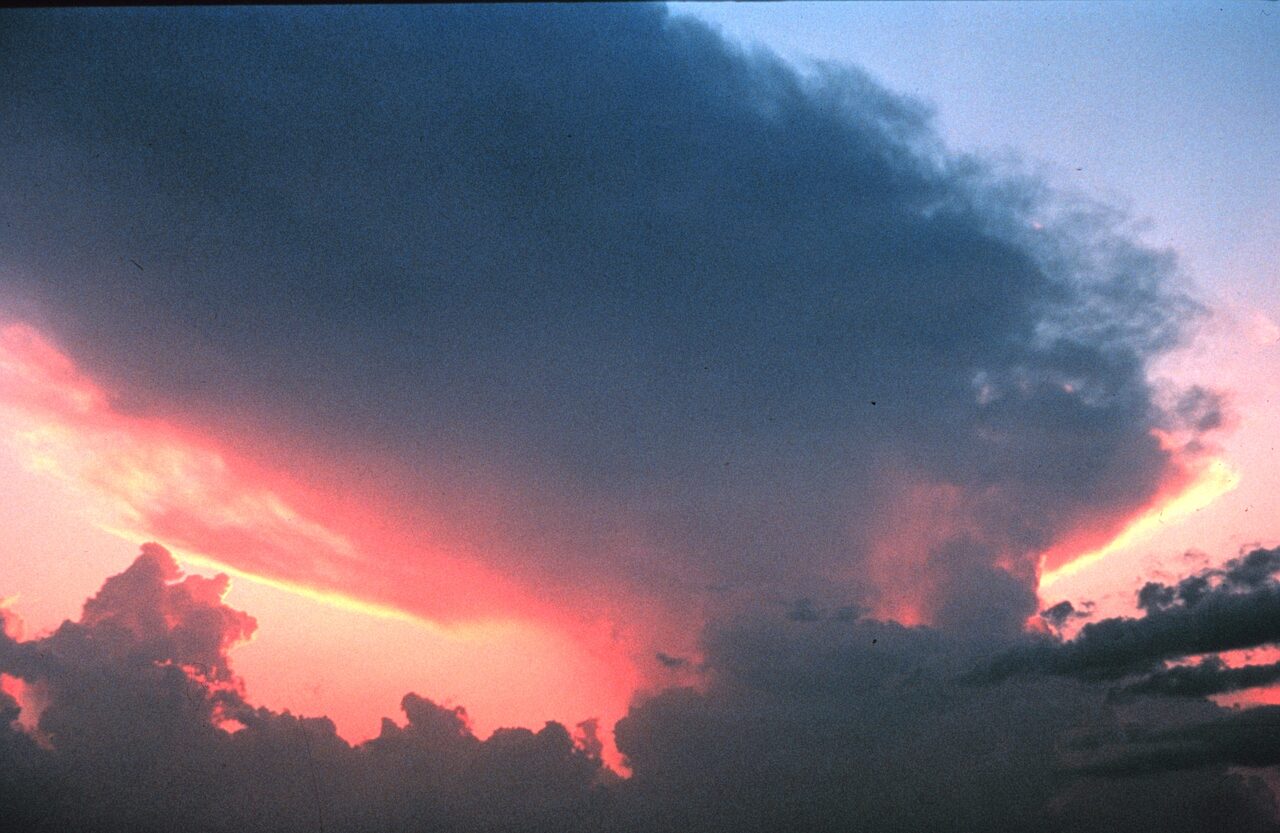
Types, least to most severe:
- Air-mass / single-cell: short-lived, from afternoon heating, usually isolated.
- Multicell: a cluster of cells in different stages, longer-lived.
- Squall line: a line of storms ahead of or along a cold front, often a solid line that is hard to cross.
- Supercell: one long-lived rotating storm, the source of the biggest hail and tornadoes.
Hazards: severe turbulence, hail (thrown out beyond the cloud), lightning, structural icing, low-level wind shear from the gust front, tornadoes, and the microburst (downburst): an intense, localized downdraft that fans out at the surface, deadly on approach or departure.
Source note: the thunderstorm theory here (three ingredients, the towering cumulus -> mature -> dissipating life cycle, storm types, and hazards) is grounded in the FAA Aviation Weather Handbook (FAA-H-8083-28), a free public-domain text; the physics is universal and matches the Canadian material (equivalent to TP 9352). The Canada-specific hazard and low-level-wind-shear guidance stays cited to the TC AIM AIR 2.7 and 2.8.
Trap: thinking a storm needs only heat, or only moisture. It needs all three ingredients. And the mature stage, not the towering cumulus, is the dangerous one, because that is where the downdrafts and gust front appear.
References
- FAA Aviation Weather Handbook (FAA-H-8083-28)
- TC AIM AIR 2.7 (flight near thunderstorms: hazards)
- TC AIM AIR 2.8 (low-level wind shear / microburst)